Internet of Things#
The Internet of Things (IoT) is the network of physical objects or “things” embedded electronics, software, sensors, and network connectivity, which enables these objects to collect and exchange data. IoT allows objects to be sensed and controlled remotely across existing network infrastructure.
“Things,” in the IoT sense, can refer to a wide variety of devices such as heart monitoring implants, biochip transponders on farm animals, electric clams in coastal waters, automobiles with built-in sensors, DNA analysis devices for environmental/food/pathogen monitoring or field operation devices that assist fire-fighters in search and rescue operations.
Components of IoT
Smart Systems and Internet of Things are driven by a combination of:
Sensors
Connectivity
People & Processes
Scope of IoT#
Internet of Things can connect devices embedded in various systems to the Internet. When devices/objects can represent themselves digitally, they can be controlled from anywhere. The connectivity then helps us capture more data from more places, ensuring more ways of increasing efficiency.
Corporate Aspect of IoT#
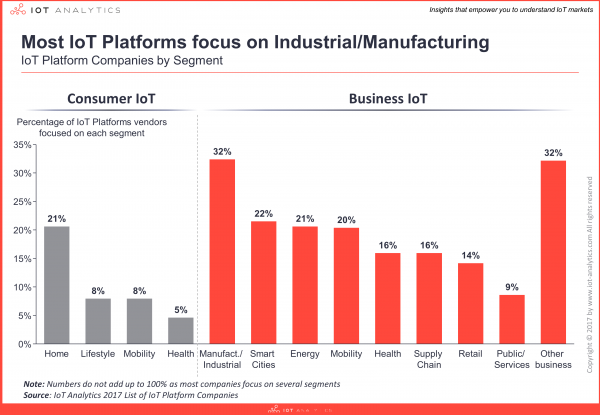
IoT is a transformational force that can help companies improve performance through IoT analytics and IoT Security to deliver better results. Businesses in the utilities, oil & gas, insurance, manufacturing, transportation, infrastructure and retail sectors can reap the benefits of IoT by making more informed decisions, aided by the torrent of interactional and transactional data at their disposal.
Source: IoT Analytics#
Challenges Faced by IoT#
At present, IoT is faced with many challenges, like:
Scalability
Security
Technical Requirements
Technological Standardization
Software Complexity
Getting Started with IoT#
A microcontroller is a compact, self-contained computer on a single integrated circuit (IC) designed to govern specific operations inside embedded systems.
Arduino UNO#
Raspberry Pi 4B#
SIK Components#
A momentary tactile switch used as a digital input. It allows a microcontroller to detect user interaction (such as a button press) and trigger actions in code.
Component Type: Digital Input
A small, analog variable resistor used in electronic kits to fine-tune, calibrate, or set voltage levels in a circuit.
Component Type: Analog Input
A light-sensitive, analog component whose electrical resistance changes based on the amount of light hitting its surface.
Component Type: Analog Input
An electrically-operated mechanical switch that lets a low-power signal from an Arduino or microcontroller safely control high-voltage or high-current devices.
Component Type: Digital Output
A linear analog device that measures ambient temperature and converts thermal changes into an electrical voltage signal.
Component Type: Analog Input
A passive, variable resistor that changes its electrical resistance depending on how much it is bent.
Component Type: Analog Input
A thing, flexible, touch-sensitive ribbon sensor that functions as a variable resistor or voltage divider based on where you press along its surface.
Component Type: Analog Input
A single component that packages three distinct color diodes—red, green, and blue—into one unit to mix and display a full spectrum of colors.
Component Type: Digital and Analog Output
A short insulated or uninsulated electrical wire with connector pins or sockets at each end, used to connect, configure, or bridge points on a breadboard, Arduino, or microcontroller without soldering.
A fundamental electronic component that limits or regulates the flow of electrical current in a circuit.
An electronic component that acts as a one-way valve for electricity, allowing current to flow in only one direction.

A small electronic component that converts mechanical stress into an electrical signal, or conversely, applies an electrical voltage to produce physical movement or sound waves.
A miniature semiconductor component that controls the flow of electricity in a circuit.
An electromechanical device that converts direct current electrical energy into mechanical rotational energy through magnetic field interactions.