Directed Graphs#
A directed graph is a pair \((V, E)\) consisting of a non-empty set of vertices \(V\) and a set of directed edges \(E\) with \(E \subseteq V \times V\).
A directed edge is sometimes called an arc.
A directed edge \((u, v)\) starts at \(u\) and ends at \(v\). In other words, the directed edge has initial vertex \(u\) and terminal vertex \(v\).
Note that “simple directed graphs”, “directed multigraphs”, “simple (undirected) graphs”, and “(undirected) multigraphs” are all different.
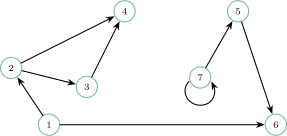
A directed graph with 7 vertices and 8 directed edges.#
The in-degree of a vertex \(v\) in a directed graph is the number of edges which terminate at \(v\). It is denoted \(deg^-(v)\).
The out-degree of a vertex \(v\) in a directed graph is the number of edges which start at \(v\). It is denoted \(deg^+(v)\).
When a vertex in a directed graph has out-degree \(0\), we call that vertex a sink.
When a vertex in a directed graph has in-degree \(0\), we call that vertex a source.
Proof
Every edge in the graph has an initial vertex and a terminating vertex. Therefore, the total number of incoming edges in the graph is equal to the sum of the in-degrees of all vertices. The total number of outgoing edges is also equal to the sum of the out-degrees of all vertices.
Directed Connectivity#
A directed path (or simply path) of a directed graph \(G = (V, E)\) is a sequence of vertices \((v_n)\) where \((v_i, v_{i+1}) \in E\) for \(1 \leq i < n\).
In a directed graph, you must “follow the arrows”. Edges can only be traversed from its initial vertex to its terminal vertex. We thus have the first kind of connectivity for a directed graph, which is the same definition (although different meaning) for a directed graph.
A directed graph is strongly connected if there is a directed path from every vertex to very other vertex.
In particular, as a corollary of this definition, a strongly connected directed graph cannot have any sink vertices or any source vertices. This is a natural consequence of the definitions.
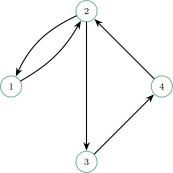
A strongly connected graph.#
The graph shown above is strongly connected since a path exists from every vertex to every other vertex. It may be a rather complex path, a path exists nonetheless. For example, the path \((3, 4, 2, 1)\) connects node \(3\) to node \(1\), the path \((1, 2, 3)\) connects node \(1\) to node \(3\), etc.
Given a directed graph \(G = (V, E)\), its underlying graph is the undirected graph obtained by replacing every directed edge with an undirected edge.
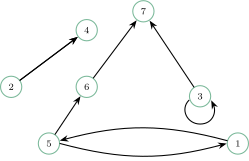
A directed graph with 7 vertices and 7 edges.#
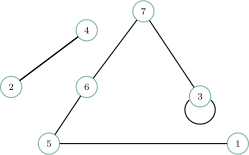
The underlying graph. Notice that the edges \((1, 5)\) and \((5, 1)\) collapsed to \(\{1, 5\}\).#
A directed graph is weakly connected if its underlying graph is connected.